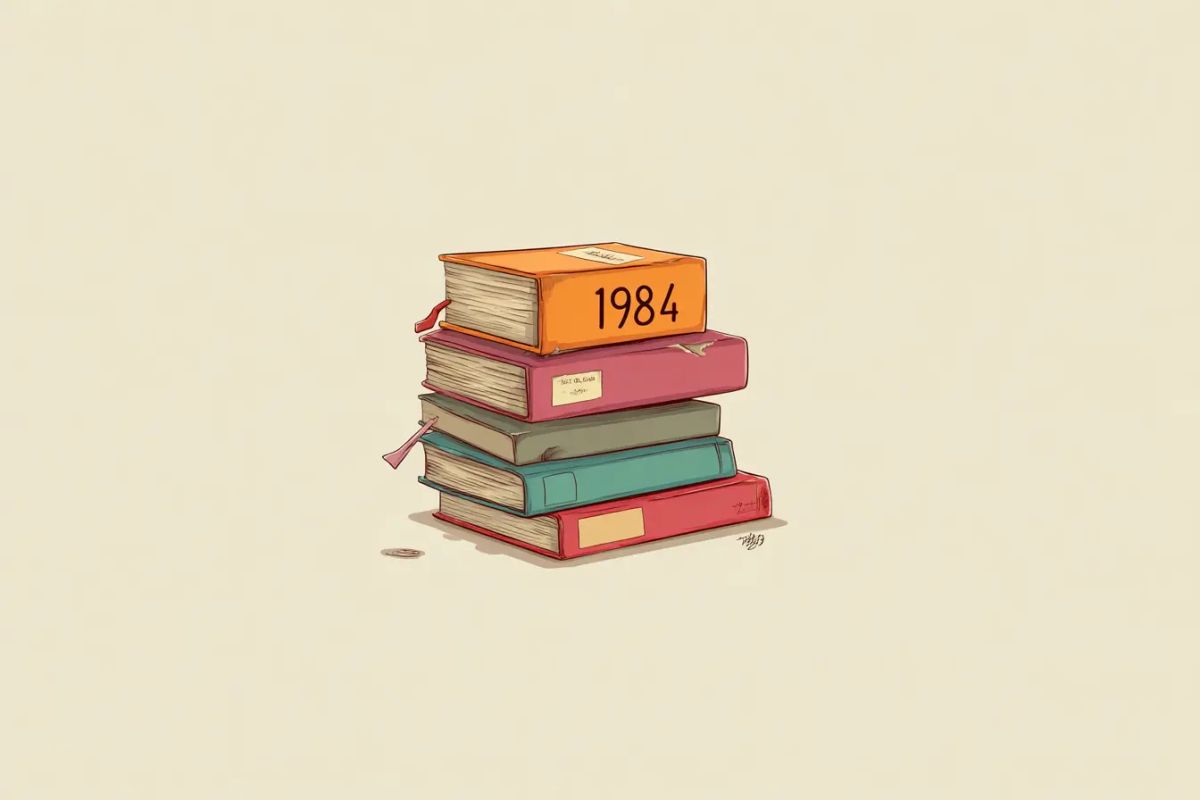
Some novels stay in your mind because they make you question the world around you. 1984 is one of those books. It feels frighteningly familiar: the blurred line between truth and lies, the fear of losing one’s voice, the unbelievable bravery of resisting control.
If you also love this novel and are looking for books like 1984, there’s a whole group of stories that explore similar topics, each in its own way.
These selections don’t imitate Orwell. They offer their own answers (or let the readers discover theirs) to the same essential questions: Who controls the truth? What does freedom actually mean? And how much can a person resist before breaking?
Brave New World — Aldous Huxley
Huxley imagines a future in which people are engineered in hatcheries, raised in tightly controlled castes, and conditioned from childhood to avoid discomfort, curiosity, and deep emotions. The world looks clean, efficient, and endlessly entertaining, yet everything meaningful has been traded away for stability. The characters live busy, pleasure-filled lives that somehow feel hollow the moment you look closer.
What feels similar to 1984: both novels show societies in which the state infiltrates the human mind and shapes instincts so people don’t even realize they’re being controlled. Their freedom is destroyed, not only by laws but also by the most powerful propaganda. It’s a direct rewrite of what people desire, fear, and value.
The key differences: Huxley’s nightmare is painless and almost seductive. His characters aren’t tortured or watched; they’re numbed and entertained into obedience. Instead of Big Brother, there’s an endless stream of distractions, which makes the loss of freedom feel disturbingly pleasant.
Fahrenheit 451 — Ray Bradbury
This is one of the best books to read if you like 1984. Its main character, Montag, lives in a future where books are burned because they provoke emotions and independent thoughts. His job as a fireman is to destroy these dangerous objects, but he begins to question everything after meeting people who still cherish stories. The more he sees, the clearer it becomes that his society uses noise and empty entertainment to keep everyone comfortably ignorant.
What feels similar to 1984: Bradbury and Orwell both focus on the power of truth and on what happens when a government tries to erase it. Montag’s awakening mirrors Winston’s: a lonely realization that everyone around him has accepted a lie.
The key differences: Bradbury leaves small openings for light. Human connection and quiet rebellion still survive beneath the surface. The world is broken, but not completely suffocating, and that difference shifts the emotional tone from despair to fragile hope.
The Handmaid’s Tale — Margaret Atwood
In Gilead, women are stripped of rights, renamed, and assigned roles based on their fertility. Offred, forced into reproductive servitude, moves through a world filled with fear and regulation. Her memories of her old life give the novel its emotional core, and the quiet tension in her daily routine shows how a person tries to hold on to a sense of self when everything around her is designed to erase it.
What feels similar to 1984: both books explore systems that enforce obedience and weaponize ideology. The constant surveillance and the danger of small mistakes feel immediately Orwellian.
The key differences: Atwood grounds her story in the body: motherhood, desire, trauma, and the personal cost of losing control over one’s identity. Instead of a broad political view, she focuses on how tyranny reshapes intimate relationships and private inner spaces.
We — Yevgeny Zamyatin
Zamyatin’s world is a mathematically ordered society where privacy doesn’t exist, and daily life is mapped out down to the minute. People are referred to by numbers, decisions are made collectively, and “unpredictable” emotions are treated as illnesses. The story follows D-503, a loyal citizen whose orderly life begins to crack when he experiences desire for the first time.
What feels similar to 1984: many of the foundations of 1984 trace back to this novel: the surveillance, the suppression of individuality, the language of mathematical perfection. It’s a blueprint of the totalitarian mindset.
The key differences: the writing is more experimental, almost feverish. Zamyatin uses more symbolism and psychological twists and creates a strange, dreamlike atmosphere instead of Orwell’s realistic one. His dystopia feels artistic and weird, not cold and bureaucratic.
Never Let Me Go — Kazuo Ishiguro
This novel begins as a nostalgic story about children at a boarding school, but then slowly reveals itself as something far darker. The students sense that they’re different, but they don’t fully understand their purpose until adulthood. The beauty of the novel lies in its subtlety: the horror is never shouted, only whispered through routines and the things left unsaid.
What feels similar to 1984: both novels explore the moment when a person realizes that the life handed to them was shaped by someone else. The theme of predetermined roles and the quiet struggle for meaning feels very close to Orwell’s emotional core.
The key differences: Ishiguro isn’t interested in political structures. His story is about love, loss, and the small emotional choices people make when resistance isn’t possible.
The Power — Naomi Alderman
A sudden biological shift gives women the ability to produce electricity, flipping global power structures overnight. Governments panic, communities reorganize, and long-standing social hierarchies crack open. The novel follows several characters across different countries, showing how quickly a world can transform when old rules no longer apply.
What feels similar to 1984: Alderman studies power the way Orwell studies control: as something that reshapes morality and relationships. Both books ask what people become when they feel untouchable.
The key differences: instead of one rigid authoritarian state, the world of The Power is chaotic and unpredictable. It’s less about stability and more about how power mutates when no one controls the narrative.
The Trial — Franz Kafka
Josef K. finds himself charged with a crime he knows nothing about. Every attempt to seek clarity only draws him deeper into a maze of offices and nonsensical procedures. The atmosphere is suffocating, not because of violence, but because of the sheer impossibility of understanding the forces working against him.
What feels similar to 1984: both novels capture the helplessness of facing a system too large to comprehend. The fear of unseen judgment and the erosion of self are central to both stories.
The key differences: Kafka’s world is absurd, not ideological. There is no doctrine, no Big Brother. There is just chaos masquerading as order. Oppression doesn’t follow logic; it simply exists, making the experience more surreal than political.
Station Eleven — Emily St. John Mandel
After a pandemic destroys most of humanity, a troupe of actors and musicians travels between settlements performing Shakespeare. The novel weaves together timelines from before and after the collapse, showing how memory and community survive in the ruins.
What feels similar to 1984: like Orwell, Mandel thinks about what holds a society together and what happens when shared stories crumble. The novel cares deeply about truth and the meanings people choose to preserve.
The key differences: this is a world rebuilt from loss, not controlled by authority. Instead of ideology, we see kindness and the instinct to rebuild. The tone is gentle, often hopeful, even when the world is broken.
The Giver — Lois Lowry
Jonas lives in a peaceful community where emotions are controlled, and memories of the past are locked away. When he becomes the Receiver of Memory, he discovers the experiences society has erased in the name of harmony. His growing awareness pushes him to question everything that once felt normal.
What feels similar to 1984: both books show societies built on carefully managed ignorance. Once the protagonist learns the truth, the manufactured calm around him breaks apart, revealing how much freedom has been sacrificed.
The key differences: Lowry’s story is written with clarity and warmth. It guides readers toward big questions without overwhelming them with darkness. It’s a dystopia with emotional simplicity and a more open ending.
These books, similar to 1984, explore power, truth, memory, and the fragile sense of self that survives even in oppressive worlds. It´s a great list for anyone who wants to see how different writers approach the same timeless anxieties.
FAQ
What genre is 1984?
1984 is a dystopian novel, but it’s also political fiction, social commentary, and psychological drama all at once. It imagines a future shaped by fear, surveillance, and absolute control, using that world to explore how power can reshape truth and identity. The mood is bleak, reflective, and deeply focused on what happens to a person when freedom disappears from every corner of life.
Are 1984 and Animal Farm similar?
They do have things in common: both discuss how totalitarian systems grow, how power distorts people. But they tell these ideas in very different ways. Animal Farm is a short satirical allegory. It uses animals to show how revolutions can turn into something darker. 1984 is much heavier; the plot places you inside a full dictatorship where fear and misinformation shape everyday life. If you want to find books like Animal Farm, look for stories that mix politics with fable-style storytelling, like Lord of the Flies, Gulliver’s Travels, or the modern classroom satire The Wave.
Is 1984 still relevant today?
Yes. Many elements of 1984 still appear in parts of the modern world, which is why the book continues to feel current. In countries such as China, North Korea, Iran, and Russia, to name a few, governments tightly control the media, limit access to independent information, and monitor online activity in ways that echo some of Orwell’s warnings. State-run narratives often replace open debate, and citizens can face real consequences for speaking against official positions. These are not fictional ideas but documented realities that mirror the book’s concerns about censorship, propaganda, and the reshaping of truth.
Because of this, 1984 remains a valuable way to think about how power works and how easily information can be manipulated. It can even help readers recognize the early signs of systems that restrict freedom and silence independent thought.